
3 Post-Accident Headache Types Portland Patients Misdiagnose
Most Portland patients who come in after a crash describe their headache the same way: “It started after the accident and won’t go away.” That description is accurate — but it tells a clinician almost nothing about what’s actually wrong. The diagnosis determines the entire treatment plan, and three distinct headache types are responsible for the majority of post-accident cases we see. Each one has different origins, different clinical signs, and critically, different treatment protocols. Treating the wrong type doesn’t just waste time — it can actively delay recovery.
This article breaks down those three types, explains how clinicians tell them apart, and clarifies why chiropractic treatment for headaches after a car accident must be matched to a specific diagnosis to be effective.
Why Post-Accident Headaches Are Not All the Same
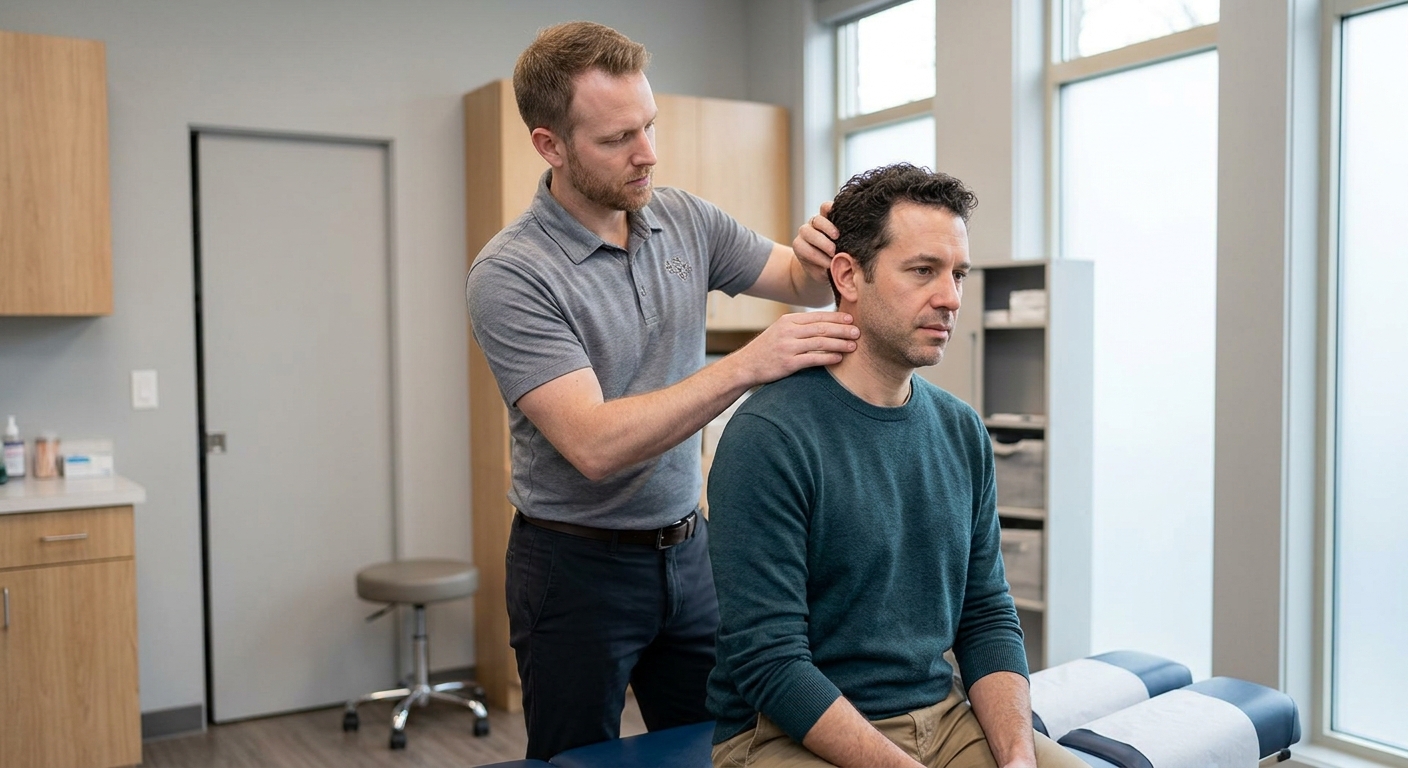
After a collision, patients often assume the headache is a single, self-explanatory symptom — something to manage with ibuprofen until it passes. What’s actually happening is that the impact has potentially stressed three different anatomical systems: the cervical joints and discs, the surrounding musculature, and the peripheral nerves at the base of the skull. Any one of these, or a combination, can generate head pain. The location of that pain, what makes it worse, and how it behaves over time are all diagnostic signals — not just discomfort to suppress.
Generic headache treatment — whether that’s over-the-counter medication from a pharmacy or a non-specific adjustment protocol — fails because it doesn’t account for which system is generating the pain. Patients who plateau after a few weeks of care, or whose headaches return repeatedly, often haven’t received a wrong treatment. They’ve received a non-specific treatment applied to a problem that required precision.
The Three Most Common Post-Accident Headache Types Seen in Portland Patients
Cervicogenic Headache
Cervicogenic headache originates from the cervical spine — specifically from the joints, discs, or muscles of the upper neck. The term means “arising from the cervix,” referring to the neck. Patients typically describe a dull, aching pain that starts at the base of the skull or the upper neck and radiates forward toward the forehead or behind one eye. It is almost always unilateral, meaning it affects one side.
Neck movement reliably aggravates it. Patients often report that turning their head to check mirrors, or sleeping on one side, triggers or intensifies the headache. This pattern — head pain that worsens with specific neck positions — is a hallmark sign that separates cervicogenic headache from other types.
Post-Traumatic Tension-Type Headache
Post-traumatic tension-type headache is driven by sustained muscle guarding in the neck, shoulders, and upper back following a crash. The nervous system responds to impact with a protective bracing response. When that muscle tension doesn’t resolve, it creates chronic referred pain into the head. Patients describe a bilateral pressure — often likened to a tight band around the forehead or a weight pressing down on the top of the skull.
Stress, poor posture, and prolonged screen time tend to spike this headache type. Unlike cervicogenic headaches, these are rarely worsened by a single neck movement. They build gradually across the day and often feel worst by late afternoon.
Occipital Neuralgia
Occipital neuralgia involves irritation or compression of the greater or lesser occipital nerves, which run from the upper cervical spine through the suboccipital muscles and up the back of the skull. Patients describe sharp, electric, or shooting pain starting at the base of the skull, sometimes radiating over the top of the head toward the eye. The scalp may feel tender to the touch, and even light pressure — from a pillow or a hat — can provoke symptoms.
This type is frequently misidentified as migraine because of the intensity and the eye involvement. The key distinguishing feature is the localized tenderness at the occipital ridge and the nerve-like quality of the pain, rather than the throbbing, nausea-associated pattern of true migraine.
How Each Headache Type Is Identified in a Clinical Setting
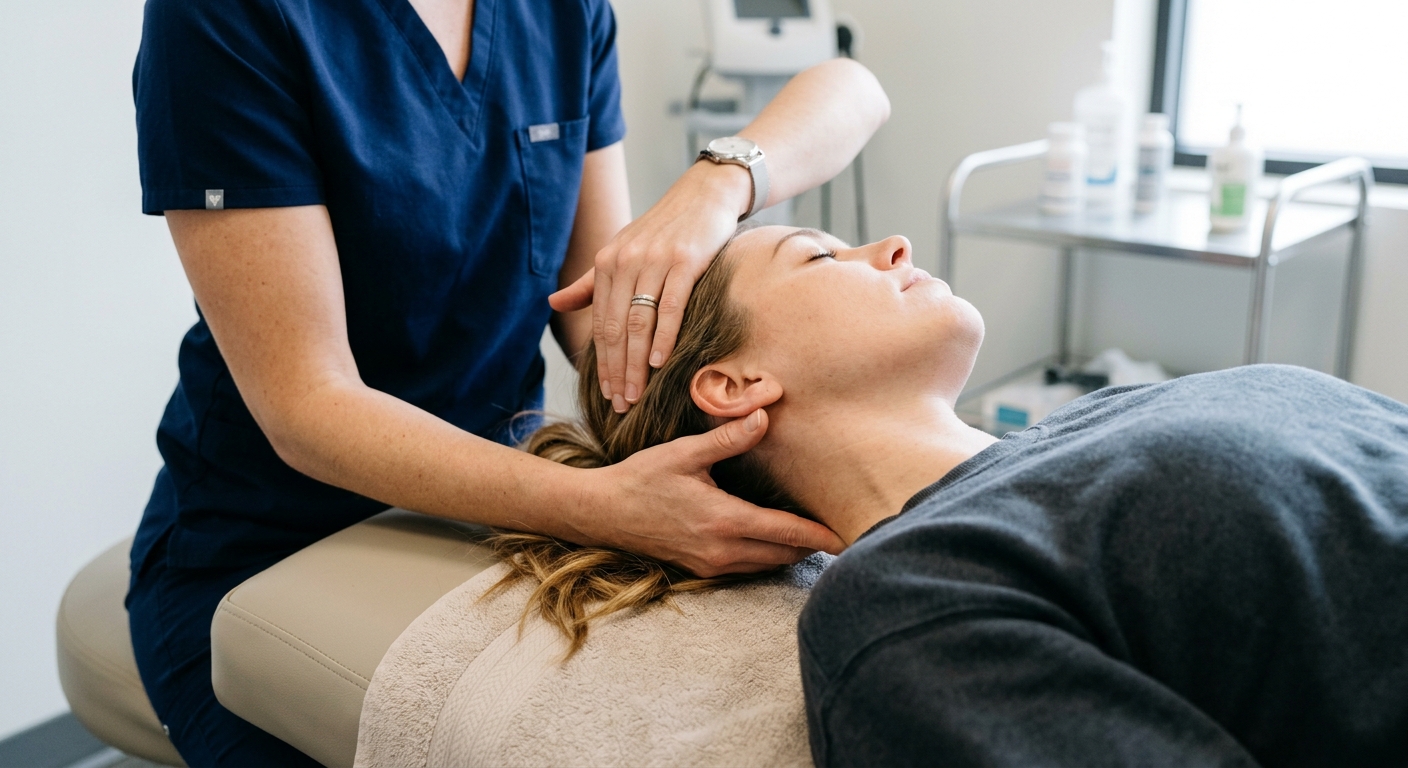
Differentiating these three types requires a structured evaluation, not just a symptom checklist. For cervicogenic headache, the Flexion-Rotation Test is a primary assessment tool. The patient lies supine while the clinician fully flexes the neck and then rotates the head to each side. Restricted rotation — typically less than 44 degrees toward the symptomatic side — combined with reproduction of familiar head pain points to C1-C2 joint involvement.
For occipital neuralgia, palpation of the suboccipital triangle — the region just below the skull between the two large neck muscles — is essential. Firm pressure over the greater occipital nerve that reproduces the patient’s exact headache pattern is a strong diagnostic indicator. The Spurling Test, which screens for cervical radiculopathy by compressing the neural foramen, helps rule out nerve root involvement further down the spine.
Tension-type headaches are identified largely by exclusion combined with postural assessment. Clinicians look for forward head posture, elevated and internally rotated shoulders, and diffuse tenderness across the upper trapezius and levator scapulae muscles. Patient history questions focus on symptom timing, work posture, and stress levels — factors that don’t influence cervicogenic or occipital presentations as directly.
It’s worth noting that ER visits after a crash — which are important for ruling out fracture, intracranial bleeding, or concussion — rarely involve this level of musculoskeletal differentiation. The ER’s role is to rule out emergencies, not to diagnose soft tissue headache subtypes. That’s where a post-accident chiropractic evaluation picks up. Patients with red-flag findings such as sudden severe headache, neurological deficits, or headaches following a confirmed concussion should be co-managed with a neurologist before manual therapy proceeds.
Why Treatment Differs Depending on the Diagnosis
Cervicogenic headaches respond well to cervical joint mobilization and segmental adjustments targeting C1-C2 and C2-C3. The goal is restoring restricted joint motion and reducing nociceptive input — the pain signals — from the irritated joint capsule. Patients with this diagnosis often notice meaningful improvement within four to six visits when the correct segments are addressed.
Tension-type headaches require a different focus: soft tissue release of the upper trapezius, sternocleidomastoid, and suboccipital muscles, combined with postural rehabilitation. Adjustments to the thoracic spine are often more relevant here than cervical adjustments alone. Without addressing the muscular guarding pattern and the postural load driving it, headaches return as soon as the patient returns to normal activity.
Occipital neuralgia calls for nerve-focused manual therapy — specifically, release of the suboccipital musculature that is compressing or irritating the nerve, combined with activity modification to reduce sustained neck flexion. Some patients also benefit from instrument-assisted soft tissue work along the nerve’s pathway. This is not a condition that responds well to aggressive cervical manipulation in the acute phase; the nerve needs decompression, not additional mechanical stress.
A patient treated for tension headaches when they actually have a cervicogenic pattern will plateau quickly. The muscles may feel temporarily better, but the restricted C1-C2 joint continues generating pain signals. This mismatch is one of the most common reasons Portland crash patients report that their headache treatment “worked for a few days and then stopped.”
Common Mistakes Portland Accident Patients Make That Delay Relief

Waiting more than two weeks after a crash to seek evaluation allows muscle guarding patterns to become entrenched and joint restrictions to stiffen further. Earlier assessment produces clearer clinical findings and faster treatment response. This is especially true for occipital neuralgia, where early nerve decompression can prevent the sensitization that makes the condition harder to treat over time.
Self-medicating with OTC pain relievers is another common delay factor. NSAIDs and acetaminophen address the sensation of pain without touching the structural cause. Patients sometimes interpret temporary relief as improvement and delay professional evaluation — only to find the headache returns as medication wears off.
Equally problematic is accepting an initial diagnosis without reassessment if symptoms persist. Headache types can overlap, and presentations can evolve. If a treatment plan isn’t producing measurable improvement within three to four weeks, the diagnosis itself should be revisited. For more on the kinds of errors that extend recovery timelines, the spinal injury mistakes Portland crash victims commonly make covers several patterns that apply directly to headache cases.
Finally, incomplete intake information delays accurate diagnosis. Patients who don’t describe the full mechanism of impact — the direction of force, whether they braced before impact, whether their head struck the headrest or window — make it harder for clinicians to predict which structures are most likely involved.
What to Expect From a Headache-Focused Post-Accident Evaluation
A thorough headache evaluation after a crash includes posture analysis, cervical range of motion measurement in all six planes, a neurological screen for upper extremity sensation and reflexes, and targeted orthopedic tests like those described above. Findings are documented in detail — both for clinical decision-making and for PIP (Personal Injury Protection) insurance purposes, which in Oregon covers chiropractic care with no upfront cost to the patient.
Cervicogenic headaches typically show measurable improvement within four to eight visits. Tension-type headaches may take longer if postural rehabilitation is required. Occipital neuralgia timelines vary based on how long the nerve has been irritated. Realistic expectations, set at intake, help patients stay consistent with care rather than abandoning a plan before it has time to work. For context on how Portland crash recovery typically unfolds, the phase-by-phase MVA recovery timeline provides a useful framework.
Local Considerations: Portland Crash Patterns and Headache Risk

Rear-end collisions on the Ross Island Bridge approach and low-speed merge crashes on I-205 are among the most common impact types we see in Portland. Low-speed rear-end impacts — even those producing minimal vehicle damage — generate rapid cervical extension-flexion forces that are strongly associated with cervicogenic headache and occipital neuralgia. The absence of visible car damage does not reflect the force transmitted to the occupant’s neck.
Parking lot impacts, which are frequent in Portland’s dense inner eastside and Pearl District neighborhoods, tend to produce lateral-force injuries. These can create asymmetric joint restrictions that present as unilateral cervicogenic headache — a pattern that’s easy to miss without side-specific orthopedic testing.
At Premier Care Chiropractic, we’ve been evaluating and treating post-accident headaches in Portland since 2016. Our board-certified Chiropractic Sports Physician and licensed chiropractic physicians use the differentiated assessment approach described above as standard protocol — because we’ve seen firsthand how often the wrong headache label leads to the wrong treatment and a much longer recovery.
Get a Headache Evaluation Matched to Your Specific Diagnosis
If your post-accident headache hasn’t responded to treatment, the diagnosis may be the problem — not the care itself. Premier Care Chiropractic offers same-day appointments for Portland crash patients, with no upfront costs under Oregon PIP insurance. Call 971-544-7058 to schedule a headache-focused evaluation and find out which type you’re actually dealing with.