
Portland Car Crash Injury Doctor: ER vs. Chiro vs. Urgent Care
After a Portland car crash, most people go to the emergency room — not because it’s the best fit for their injury, but because it’s the most familiar option. That default choice has real consequences. Depending on what’s actually hurt, the ER may miss the most important injuries entirely, and a different provider type would have served you better from day one. This guide breaks down what each provider type actually does, what it costs, and which crash injuries each handles best.
Why Your Provider Choice Shapes Recovery — Not Just Cost
Choosing a Portland car crash injury doctor isn’t just a logistical decision. It affects how quickly soft tissue damage is identified, how well your injuries are documented for an Oregon PIP (Personal Injury Protection) claim, and whether you end up with chronic pain that was preventable with earlier intervention.
Each provider type — emergency room, urgent care, primary care physician, and crash-focused chiropractor — operates with different tools, different billing structures, and different training priorities. Understanding those differences lets you match your situation to the right setting instead of guessing.

Emergency Room: Trauma Strengths and Soft Tissue Blind Spots
The ER excels at ruling out life-threatening injuries. If you lost consciousness, have chest pain, suspect internal bleeding, or show signs of a serious concussion, the emergency room is the right first stop. Portland-area trauma centers carry CT scanners, X-ray equipment, and specialists capable of managing acute emergencies.
What the ER is not designed to do is assess soft tissue injuries — the sprains, ligament strains, and muscle tears that account for the majority of crash injuries. Standard ER imaging (X-ray, CT) shows bone and organ damage clearly. It does not reveal whiplash-related ligament injury, facet joint irritation, or disc bulges. A patient can receive a clean discharge and still have significant musculoskeletal injuries that will worsen without treatment.
Cost is a serious factor. A Portland ER visit without insurance typically runs $1,500–$3,500 for evaluation and basic imaging. With insurance, you may still owe a $250–$500 emergency copay plus deductible amounts. Oregon’s mandatory PIP coverage does apply to ER visits, but the high cost burns through your PIP benefit faster — leaving less for the ongoing rehabilitation most crash patients actually need.
Best for: Suspected fractures, head trauma, chest injuries, loss of consciousness, or any symptom suggesting internal damage.
Urgent Care: A Useful Middle Ground With Real Limits
Portland urgent care clinics sit between the ER and a specialist in terms of scope. They can handle minor lacerations, basic X-rays, and straightforward orthopedic complaints. For a crash patient with a small cut that needs stitches or a possible wrist fracture from bracing impact, urgent care is faster and cheaper than the ER.
Costs typically range from $150–$400 out of pocket, or a standard specialist copay with insurance. PIP can cover urgent care visits, though billing practices vary by clinic.
The limitation is the same as the ER: urgent care providers are not trained in crash-specific musculoskeletal assessment. Whiplash, cervical strain, and lumbar disc injuries are routinely missed or undertreated. Providers may prescribe anti-inflammatories and recommend rest — which addresses symptoms but not the underlying structural problem. If your primary complaint is neck pain, back pain, or stiffness after the crash, urgent care is unlikely to give you an adequate diagnosis.
Best for: Minor wounds, simple fractures, basic imaging needs, or as a bridge when no specialist is immediately available.
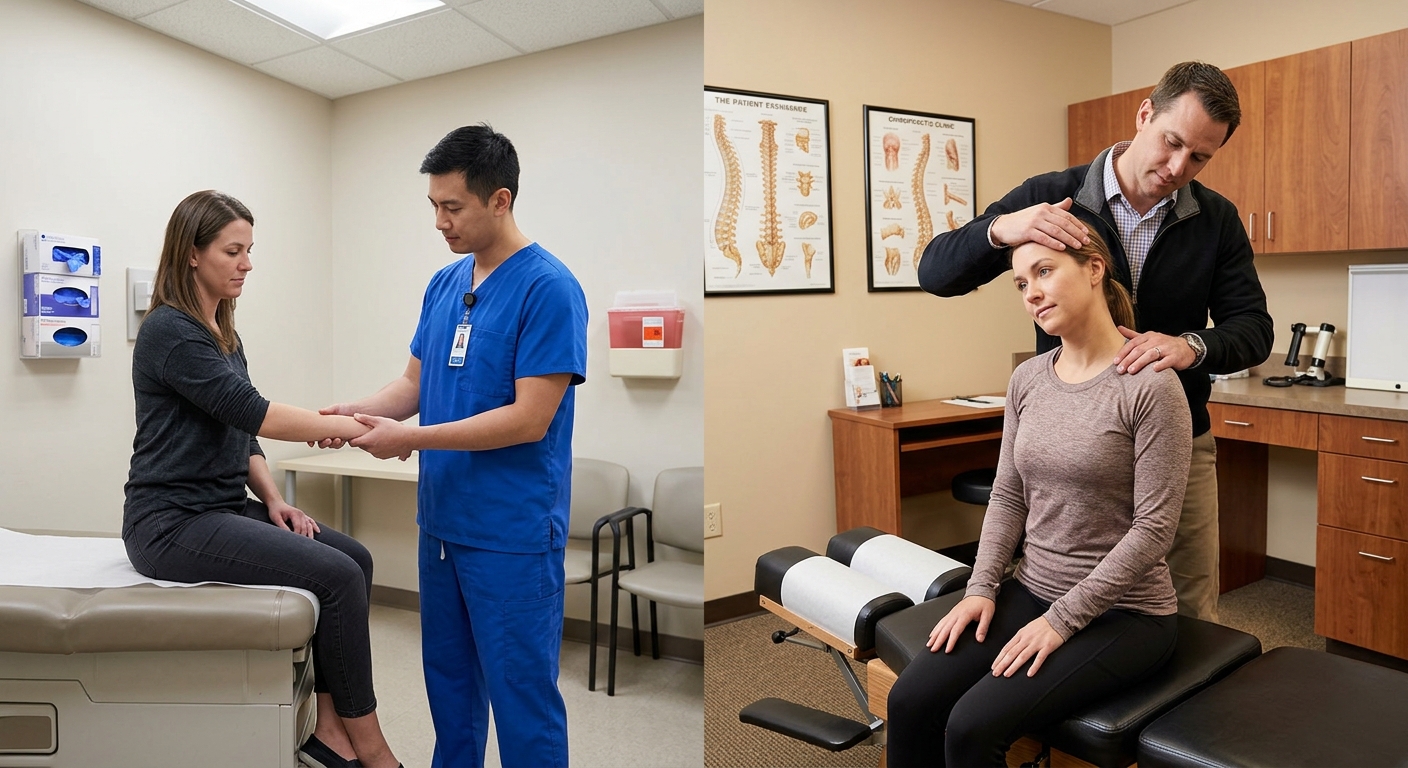
Primary Care Physician: Familiarity vs. Crash-Specific Expertise
Seeing your established PCP after a crash feels natural — they know your history, you trust them, and they can coordinate referrals. The problem is timing and specialization. Getting a same-day or next-day appointment with a PCP in Portland is difficult. Many patients wait three to seven days, which delays both treatment and injury documentation.
PCPs also vary significantly in their comfort with hands-on musculoskeletal assessment. A general practitioner may order X-rays, prescribe muscle relaxants, and refer you to physical therapy — all reasonable steps, but the referral-to-treatment timeline in Portland can add another two to four weeks before you’re actually receiving targeted care.
For Oregon PIP purposes, a PCP referral can actually help establish a paper trail. But relying solely on a PCP for crash injury management often means weeks pass before the injuries most likely to become chronic — cervical ligament strain, lumbar facet irritation — receive any hands-on treatment.
Best for: Patients with complex medical histories who need a coordinating physician, or as a complement to specialist care rather than a replacement.
Car Crash Injury Chiropractor: What Specialization Actually Means
A crash-focused chiropractic clinic operates very differently from a general wellness practice. The intake process at a clinic like Premier Care Chiropractic — which has treated Portland accident patients for nearly a decade — involves orthopedic and neurological testing, range-of-motion measurement, and palpation-based assessment of spinal joint function. These are the tools that actually detect whiplash-grade injuries that X-rays miss.
Crash-focused chiropractors also understand the documentation requirements for Oregon personal injury claims. Clinical notes from a chiropractic evaluation carry weight in PIP claims and litigation because they establish injury causation, severity, and functional limitation — details a brief ER discharge summary rarely captures. For more on what a thorough post-crash chiropractic evaluation involves, see this breakdown of what doctors check for neck injury after a Portland crash.
Under Oregon’s PIP statute (ORS 742.524), chiropractic care qualifies as a covered medical expense. Most crash patients in Portland can receive chiropractic treatment with no upfront cost — PIP pays directly to the provider. The minimum PIP benefit in Oregon is $15,000, which covers a substantial course of chiropractic treatment before any out-of-pocket expense applies.
Best for: Whiplash, cervical and lumbar strain, disc irritation, joint dysfunction, and soft tissue injuries — the most common crash injury categories.
Side-by-Side: Matching Your Injury to the Right Portland Provider
| Injury Type | Best First Provider | Reason |
|---|---|---|
| Suspected fracture | ER or Urgent Care | X-ray and orthopedic triage needed |
| Head trauma / concussion | ER | CT imaging and neurological monitoring required |
| Whiplash / neck stiffness | Crash chiropractor | Soft tissue assessment; ER/urgent care routinely miss this |
| Low back pain / strain | Crash chiropractor | Hands-on spinal assessment; faster access than PCP referral chain |
| Rib pain (non-fracture) | Urgent care first, then chiropractor | Rule out fracture, then treat costochondral strain |
| Lacerations / road rash | Urgent care | Wound care is outside chiropractic scope |
| Radiating arm/leg pain | Crash chiropractor | Likely disc or nerve root involvement; needs spinal assessment |
Oregon PIP Insurance and How Provider Choice Affects Your Claim
Oregon law requires all auto insurance policies to include PIP coverage with a minimum benefit of $15,000 per person (ORS 742.524). PIP covers reasonable and necessary medical expenses regardless of fault — meaning you can use it immediately after a crash without waiting for liability to be determined.
Not all providers handle PIP billing the same way. Most Portland hospital systems and urgent care chains will bill PIP directly, but some require you to pay upfront and seek reimbursement — a process that can take weeks. Crash-focused chiropractic clinics typically bill PIP directly with no upfront cost to the patient.
The provider you choose first also affects documentation. PIP adjusters and personal injury attorneys rely on clinical records to assess injury severity. A detailed chiropractic intake report — with range-of-motion measurements, orthopedic test findings, and a functional impairment narrative — is far more useful for a claim than a brief ER discharge note that says “neck pain, no acute fracture.” For a deeper look at how PIP interacts with chiropractic care in Oregon, the Oregon Motor Vehicle PIP Insurance Explained article covers the statute details and billing process thoroughly.
Common Mistakes Portland Crash Patients Make When Choosing a Provider
Waiting to see if the pain goes away. Adrenaline suppresses pain for hours after a crash. Many patients feel fine at the scene and wake up stiff two days later. Delayed onset is normal — delayed treatment is not. Oregon PIP claims are also time-sensitive, with a one-year statute of limitations on filing.
Assuming an ER clearance means no injury. A clean ER discharge means no acute trauma requiring emergency intervention. It does not mean your spine is uninjured. Soft tissue damage requires different tools to detect.
Not knowing PIP covers chiropractic. A significant number of Portland crash patients pay out of pocket for chiropractic care because they didn’t know their auto insurance already covers it. Oregon PIP applies to chiropractic treatment from the first visit.
Failing to document injuries early. The longer the gap between a crash and your first clinical evaluation, the harder it is to establish injury causation. Early documentation — from any qualified provider — protects both your health and your claim. For guidance on what to do in the first days after a crash, Portland Collision Injury Care: What to Do First walks through the practical steps.
Making a Confident Choice After a Portland Crash
There’s no single right answer for every patient, but there is a logical framework. If your crash involved high-speed impact, loss of consciousness, or symptoms suggesting internal injury, start at the ER. If you walked away with pain, stiffness, or headache — the most common post-crash presentation — a crash-focused chiropractor offers faster access, more targeted assessment, and direct PIP billing with no upfront cost.
The goal is matching your injury type to the provider actually equipped to treat it, rather than defaulting to whatever feels most familiar. That decision, made early, is one of the most consequential ones you’ll make in your recovery.
Talk to a Portland Car Crash Injury Doctor Today
Premier Care Chiropractic has worked with Portland crash patients since 2016. Our board-certified Chiropractic Sports Physician and licensed clinical team offer same-day evaluations, direct PIP billing, and no upfront costs for patients with Oregon auto insurance coverage. If you’re unsure which provider type fits your situation, call us at 971-544-7058 — we’ll give you an honest answer, even if that answer is to start somewhere else first.