
Portland Whiplash Treatment Options After a Car Accident
Whiplash is a soft-tissue injury caused by rapid, forceful back-and-forth movement of the neck — most commonly from rear-end collisions. If you were recently in a crash and your neck feels stiff, painful, or you’re getting headaches, whiplash is likely what you’re dealing with. The good news: most whiplash injuries respond well to conservative care, and accident chiropractic in Portland is one of the most evidence-supported first-line approaches available to you.
This article walks through the main treatment options — what each involves, when each is appropriate, and what Portland patients specifically need to know about accessing care after a crash.

What Whiplash Actually Does to Your Neck
Whiplash doesn’t just affect muscles. The rapid acceleration-deceleration force can strain or tear ligaments, irritate facet joints (the small joints between vertebrae), compress cervical nerve roots, and cause micro-tears in muscle fibers. That combination is why whiplash can produce such a wide range of symptoms — neck pain, shoulder tension, headaches, jaw discomfort, arm tingling, and even cognitive fog.
Symptoms often don’t peak until 24–72 hours after the collision. Many Portland accident patients feel fine at the scene and wake up two days later barely able to turn their head. This delayed onset is normal and doesn’t mean the injury is minor.
Understanding the injury mechanism matters because it shapes which treatments are most useful at each stage of recovery.
Chiropractic Adjustment for Whiplash
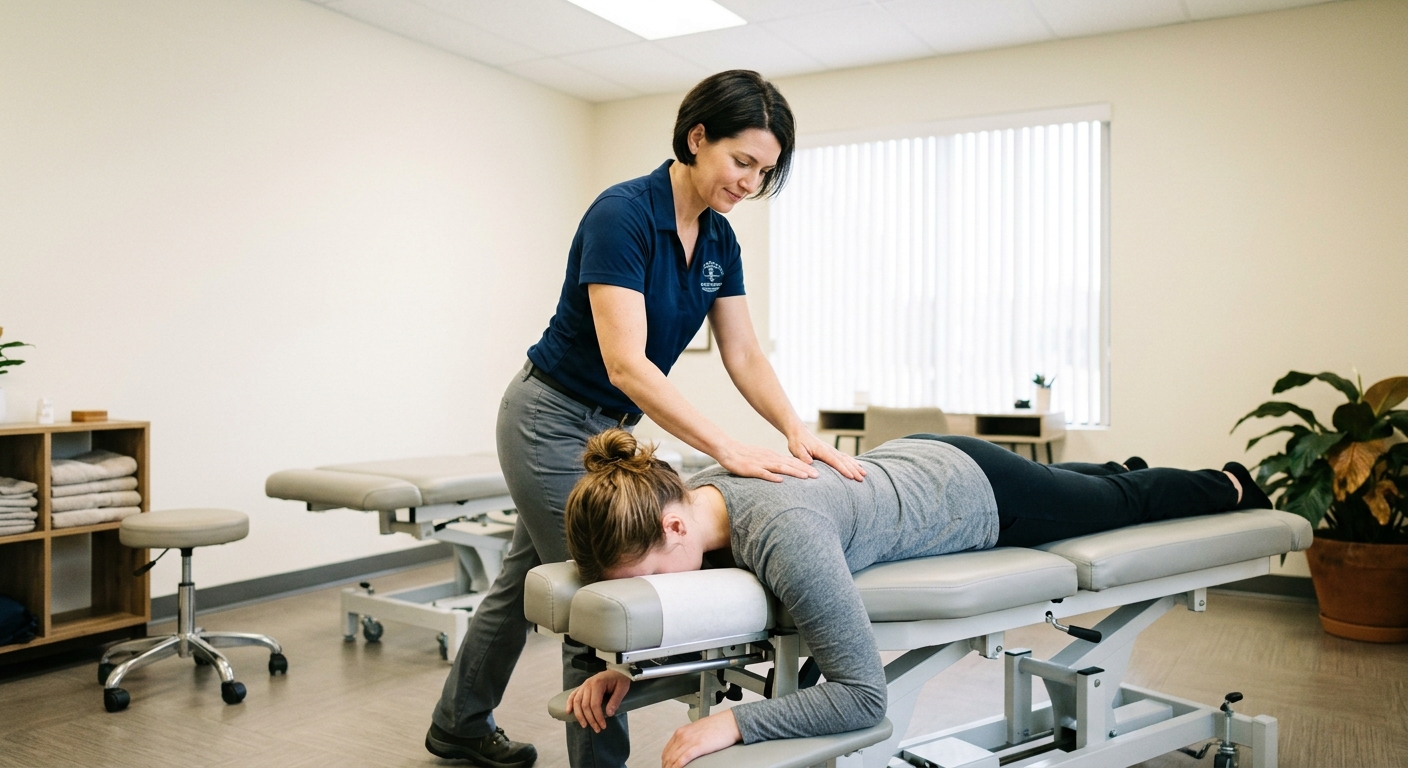
Chiropractic spinal manipulation — often called an adjustment — is the most well-known treatment in accident chiropractic care. The chiropractor applies a controlled, precise force to a specific vertebral segment to restore normal joint motion and reduce nerve irritation.
For whiplash, adjustments are typically focused on the cervical spine (neck) and upper thoracic spine (upper back), since both regions are affected by the injury force. Gentle techniques such as instrument-assisted adjusting or low-amplitude mobilization are often used in the acute phase, when inflammation is highest. More traditional manual adjustments may be introduced as the injury stabilizes.
Research supports spinal manipulation as effective for reducing pain and restoring range of motion in cervical whiplash injuries. It works best when combined with other therapies rather than used in isolation.
Soft-Tissue Therapies That Support Recovery
Chiropractic adjustments address joint mechanics, but the muscles and connective tissue surrounding the spine also need direct treatment. Several soft-tissue therapies are commonly used alongside adjustments in Portland accident chiropractic settings.
Therapeutic Massage
Licensed massage therapists trained in clinical techniques can reduce muscle guarding, break up adhesions (areas of scar-like tissue that form after injury), and improve circulation to injured tissue. Massage is particularly effective for the trapezius, levator scapulae, and suboccipital muscles — all commonly affected in whiplash. For patients with PIP (Personal Injury Protection) insurance coverage, massage therapy is often included in the covered treatment plan.
Myofascial Release
Myofascial release targets the fascia — the connective tissue sheath that surrounds muscles. After trauma, fascia can tighten and restrict movement. Sustained, low-load stretching techniques release this tension and help restore normal tissue mobility.
Trigger Point Therapy
Trigger points are hyperirritable spots within a muscle that refer pain to other areas. Cervical whiplash frequently creates trigger points that cause headaches and shoulder pain. Direct pressure or dry needling can deactivate them effectively.
You can learn more about how these modalities work together in a post-accident recovery plan on the whiplash and conditions treatment page at Premier Care Chiropractic.
Rehabilitative Exercise and Cervical Stabilization
Passive treatments — adjustments, massage, heat — reduce pain and inflammation. But lasting recovery also requires active rehabilitation. Whiplash weakens the deep cervical flexor muscles that stabilize the neck. Without retraining those muscles, pain tends to return or become chronic.
A structured exercise program typically begins with gentle range-of-motion work and progresses to isometric strengthening (contracting muscles without movement), then dynamic resistance exercises. Proprioception training — exercises that retrain your brain’s sense of where your head is in space — is also important, since whiplash disrupts the sensory receptors in cervical joints.
In Portland accident chiropractic practices that treat whiplash regularly, exercise prescription is individualized based on the patient’s injury severity, pain level, and functional goals. A board-certified Chiropractic Sports Physician has specific training in this kind of progressive rehabilitation planning.

What Portland Patients Need to Know About PIP Insurance
Oregon law requires all auto insurance policies to include Personal Injury Protection (PIP) coverage. PIP pays for your medical treatment after a car accident regardless of who was at fault. The minimum benefit is $15,000, and it covers chiropractic care, massage therapy, and other conservative treatments.
This is important for two reasons. First, you don’t need to wait for a liability determination to start treatment — PIP activates immediately. Second, you should not pay out of pocket for whiplash treatment while your PIP coverage is active. Many Portland accident patients don’t realize this and either delay care or pay bills they don’t owe.
To use PIP, you file a claim with your own auto insurer and provide the clinic with your claim number. A practice experienced in Oregon PIP billing handles the paperwork and communicates directly with the insurer, so you focus on recovery rather than administrative back-and-forth.
The treatment services page covers what’s typically included in a PIP-covered whiplash care plan.
How Soon Should You Start Treatment?
Earlier is better — with some nuance. Starting chiropractic care within the first week after a crash generally produces better outcomes than waiting. Early treatment addresses inflammation before scar tissue sets in and helps prevent the injury from becoming a chronic pain condition.
However, if you have any neurological symptoms — numbness or weakness radiating down your arm, difficulty with balance, or bowel and bladder changes — imaging (X-ray or MRI) should be done before spinal manipulation begins. A responsible chiropractor will screen for these red flags at your first visit and refer you for imaging if needed.
If you’ve already waited several weeks or months, treatment is still worthwhile. Chronic whiplash responds to care, though recovery timelines are typically longer.

Frequently Asked Questions About Whiplash Treatment in Portland
Do I need a referral to see a chiropractor after a car accident in Oregon?
No. Oregon allows direct access to chiropractic care. You can schedule an appointment without a physician referral, and your PIP coverage will apply.
How many treatments will I need?
Mild whiplash often resolves in 6–12 visits over four to six weeks. More significant injuries — those involving ligament laxity or disc involvement — may require longer care. Your chiropractor should give you a clear treatment plan with defined goals and a reassessment schedule.
Can I treat whiplash with rest alone?
Short-term rest reduces pain, but prolonged inactivity slows healing and increases the risk of chronic symptoms. Current clinical guidelines recommend staying as active as tolerable and beginning professional treatment early rather than waiting to see if symptoms resolve on their own.
What if I also have a concussion?
Whiplash and mild traumatic brain injury (concussion) frequently occur together in the same collision. A chiropractor with sports medicine training can manage both, coordinating care and modifying treatment to account for concussion symptoms. Spinal manipulation is typically deferred until concussion symptoms stabilize.
Will treatment affect my personal injury claim?
Consistent, documented treatment generally supports a personal injury claim rather than hurting it. It demonstrates that you took the injury seriously and sought appropriate care. Your treatment records are part of the evidence that establishes injury severity and economic damages.
For a deeper look at how chiropractic care integrates with accident recovery, the whiplash and conditions page outlines the clinical approach used at Premier Care Chiropractic.
Premier Care Chiropractic’s Approach to Whiplash in Portland
Premier Care Chiropractic has been treating Portland accident patients since 2016. The clinic’s providers include a board-certified Chiropractic Sports Physician and licensed massage therapists, which means the full range of whiplash therapies described in this article — adjustments, soft-tissue work, and rehabilitative exercise — are available under one roof. The practice has developed deep familiarity with Oregon PIP billing over that time, which means no upfront costs for patients with active PIP coverage and no surprise billing at the end of care.
Same-day appointments are available for recent accident patients, which matters when early treatment produces meaningfully better outcomes.
Ready to Start Whiplash Treatment in Portland?
If you were in a car accident and are experiencing neck pain, headaches, or stiffness, Premier Care Chiropractic offers same-day evaluations for Portland accident patients. There are no upfront costs when you have Oregon PIP coverage, and the team handles insurance communication directly.
Call 971-544-7058 to schedule your evaluation today.