
Your First Visit to a Portland Spine Injury Center
Walking into a spine injury center in Portland after a car accident or workplace injury can feel overwhelming — especially when you don’t know what’s about to happen. That uncertainty often makes pain feel worse and recovery feel further away. This walkthrough covers every stage of your first appointment in chronological order, from the moment you arrive to the paperwork you leave with, so you can focus on healing instead of guessing.
Before You Arrive: What to Bring and How to Prepare

Gathering the right documents before your appointment saves time and strengthens your clinical and legal record from day one. Bring your health insurance card, your auto insurance card, and your claim number if one has been assigned. If your injury resulted from a motor vehicle accident, also bring your accident report number — Oregon law requires drivers to report crashes involving injury, so this document usually exists.
If you had prior imaging — X-rays or MRI scans from an ER visit or previous provider — request a digital transfer or bring the disc. A written symptom timeline is equally valuable: jot down when pain started, how it has changed, and which activities make it better or worse. Oregon requires all auto insurance policies to carry Personal Injury Protection (PIP), which covers reasonable and necessary medical expenses regardless of fault. Bring any PIP documentation your insurer has sent, because many Portland spine injury centers, including Premier Care Chiropractic, bill PIP directly with no upfront cost to you. Many clinics also offer digital intake forms you can complete before arriving, which cuts your waiting room time significantly.
Step 1 — Intake and Health History Review
The front desk and intake coordinator collect your insurance information, verify coverage, and hand you a health history questionnaire. This takes roughly 15 to 20 minutes. The most important section is the accident mechanism description — not just where it hurts, but how the injury happened. A rear-end collision at 35 mph loads the cervical spine very differently than a side-impact crash, and that distinction shapes every clinical decision that follows.
Everything recorded here seeds your clinical file, which becomes the foundation for treatment notes, insurance billing, and — if needed — personal injury documentation. Vague intake records create gaps that insurers can use to dispute claims later. Be as specific as possible about the sequence of events, the direction of impact, and any immediate symptoms you noticed at the scene. For more on protecting your claim from the start, the guide on spinal injury mistakes Portland crash victims make covers several intake-stage errors that cost patients later.
Step 2 — Consultation With Your Spine Injury Specialist
Once intake is complete, you meet with the provider — typically a licensed chiropractic physician or board-certified chiropractic sports physician. This verbal consultation lasts 15 to 20 minutes and is more diagnostic than it might appear. The provider is listening for onset timing (did pain begin immediately or hours later?), the character of pain (sharp, burning, aching), and any neurological symptoms such as numbness, tingling, or weakness radiating into the arms or legs.
They will also ask about pre-existing conditions. This is not a trap — it is clinically necessary. A prior disc injury at C5-C6 changes how a new trauma is interpreted and treated. Ask your own questions here too: How long will treatment likely take? What are the realistic outcomes? What should I avoid doing at home? Providers who specialize in spine injury should answer these directly, not vaguely.
Step 3 — Orthopedic and Neurological Examination
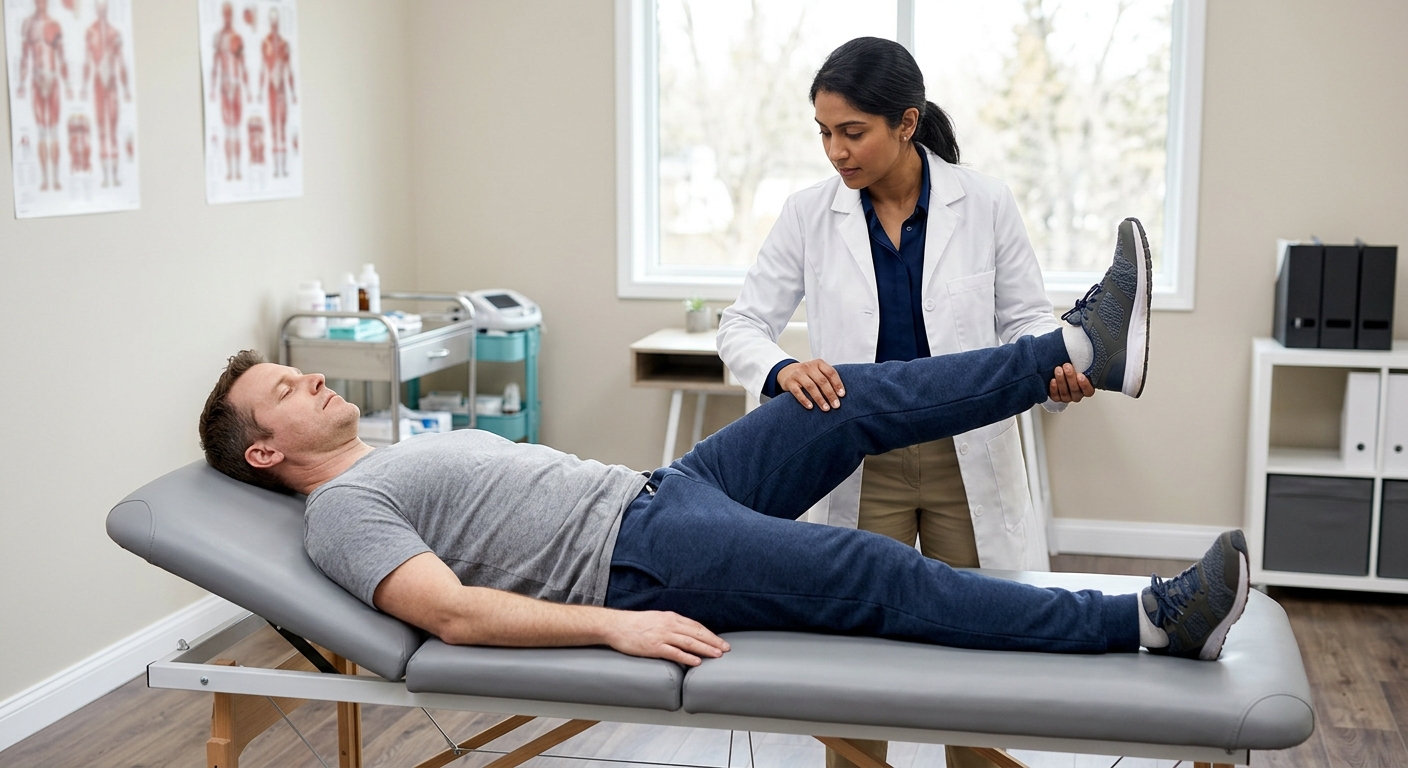
This is the most clinically dense part of the first visit and takes 30 to 45 minutes. The provider performs a structured sequence of tests designed to isolate which spinal structures are involved and whether the nervous system is affected.
Spurling’s test is used to assess cervical radiculopathy — nerve root compression in the neck. The provider gently extends and rotates your head toward the symptomatic side while applying light downward pressure. Reproduction of arm pain or tingling indicates nerve root involvement at that level. Straight leg raise (SLR) tests lumbar nerve root tension. You lie flat while the provider lifts your leg with the knee straight; pain radiating below the knee before 70 degrees of elevation suggests involvement of the sciatic nerve roots, typically L4 through S1.
Range-of-motion measurement uses a dual inclinometer or goniometer to quantify how far you can flex, extend, and rotate each spinal region. These numbers establish a baseline and are compared at follow-up visits to track progress objectively. Deep tendon reflex testing — tapping the biceps, triceps, patellar, and Achilles tendons — checks the integrity of specific spinal cord levels. A diminished or absent reflex points to nerve root compromise at a predictable segment. Motion palpation, where the provider feels each vertebral segment move through its range, identifies restricted or hypermobile joints that may not show up on static imaging.
Step 4 — Diagnostic Imaging Decision
After the physical examination, the provider decides whether imaging is needed and which type. Digital X-ray, available in-house at many Portland spine injury centers, reveals bony alignment, disc space narrowing, and fracture lines. It is the appropriate first step for most post-accident presentations. MRI, which requires a referral to an imaging center, shows soft tissue structures — disc herniations, ligament tears, spinal cord signal changes — that X-ray cannot capture.
The provider orders MRI when neurological findings from the examination suggest disc or cord involvement, when X-ray shows suspicious findings, or when symptoms are severe and progressive. Portland has several imaging centers with next-day or same-day availability, and a well-connected spine injury clinic will coordinate that referral before you leave. Understanding how Oregon PIP covers imaging costs is covered in detail in this breakdown of Oregon motor vehicle PIP insurance.
Step 5 — Review of Findings and Care Plan Presentation

Once examination and any in-house imaging are complete, the provider sits down with you to explain findings in plain language. They will show you any X-ray images, describe what the examination tests revealed, and explain the clinical diagnosis. This conversation typically takes 15 to 20 minutes.
The care plan is structured in phases. Acute phase care — typically weeks one through four — focuses on reducing inflammation, restoring pain-free range of motion, and protecting injured structures from further stress. Appointment frequency during this phase is usually three times per week. Treatment may include spinal manipulation, soft tissue therapy, therapeutic modalities such as electrical muscle stimulation or ultrasound, and guided stretching. The provider will give you a realistic estimate of total care duration based on your specific findings, not a generic timeline. For context on what recovery actually looks like week to week, the Portland rear-end collision treatment week-by-week guide maps out what patients typically experience across the first month of care.
What Documentation You Leave With
At the end of your first visit, you should receive or be told to expect several documents. Your clinical notes from the visit — including the health history, examination findings, and diagnosis — are generated and stored in your file. If imaging was taken in-house, the report is typically ready the same day. If an MRI referral was placed, you will receive referral paperwork and contact information for the imaging center.
These records serve multiple purposes. For Oregon PIP claims, they document medical necessity for every treatment billed. For workers’ compensation filings, they establish the injury date and mechanism. If you are working with a personal injury attorney, this first-visit record is often the most important document in your case because it captures symptoms closest to the date of injury.
Red Flags That Change the First-Visit Protocol
Most first visits follow the sequence above. A small number do not, because certain findings require immediate escalation. Signs of spinal cord compression — bilateral weakness, loss of bladder or bowel control, or a sensation of electric shock running down the spine with neck movement (Lhermitte’s sign) — require urgent specialist evaluation or emergency referral, not a chiropractic adjustment. Severe neurological deficits that are worsening rather than stable, or X-ray findings suggesting fracture instability, also change the protocol. In these cases, a responsible spine injury center coordinates directly with Portland-area emergency or orthopedic resources before any manual treatment begins.
Frequently Asked Questions From Portland Patients

How long will the first appointment take? Plan for 90 minutes to two hours. The examination and consultation phases cannot be rushed without sacrificing diagnostic accuracy.
Will treatment start the same day? Often yes, if imaging findings and examination results support it. Some presentations require imaging review before hands-on treatment begins.
Will my Oregon PIP insurance cover this? Oregon PIP covers reasonable and necessary medical treatment up to the policy minimum — $15,000 under current state law — regardless of fault. Most spine injury centers in Portland bill PIP directly, meaning no out-of-pocket cost at the time of service.
Do I need a referral? No. Oregon allows patients to see a licensed chiropractic physician without a physician referral. You can schedule directly.
What about parking? Premier Care Chiropractic has on-site parking available, so factor that in rather than budgeting extra time for street parking.
Premier Care Chiropractic has been treating Portland spine injury patients since 2016. The clinic’s board-certified chiropractic sports physician and licensed chiropractic physicians have structured the first-visit process specifically around the documentation requirements that Oregon PIP and personal injury cases demand — so nothing important is missed on day one.
Schedule Your First Spine Injury Evaluation
If you are ready to book your first appointment or want to ask a question before coming in, call Premier Care Chiropractic in Portland at 971-544-7058. Same-day appointments are available, and Oregon PIP patients are seen with no upfront costs.